
How long does an interior design project take in Switzerland? A realistic timeline
“When will it be ready?” That is almost always the first question asked of an interior design studio, and it is a fair one. A renovation project sits inside a family life, professional commitments, and sometimes a tenancy or sale window. Having a clear view of the timeline changes everything.
The honest answer is that there is no standard duration. But there is a realistic framework, grounded in the Swiss market, in cantonal lead times, and in years of accumulated site experience. This guide breaks down what to expect for each project type in French-speaking Switzerland, along with the factors that speed things up or slow them down.
How long to plan for: the orders of magnitude
Before going phase by phase, here are the total durations we regularly observe at RK Interiors, from the first briefing to final handover, for projects in French-speaking Switzerland.
Furnishing and decoration of a single room without structural work: 3 to 5 months. Full renovation of a 80 to 150 m² apartment: 6 to 12 months. Renovation of a 200 to 400 m² villa: 12 to 18 months. Mountain chalet project (Verbier, Crans-Montana, Chamonix): 12 to 24 months. Shop, restaurant or hotel fit-out: 4 to 10 months depending on size and technical constraints.
These ranges include design, ordering, coordination, and construction. They assume a responsive client and a project without complex permit requirements. Let’s look at what happens inside those months.
The 6 main phases of a project and their actual duration
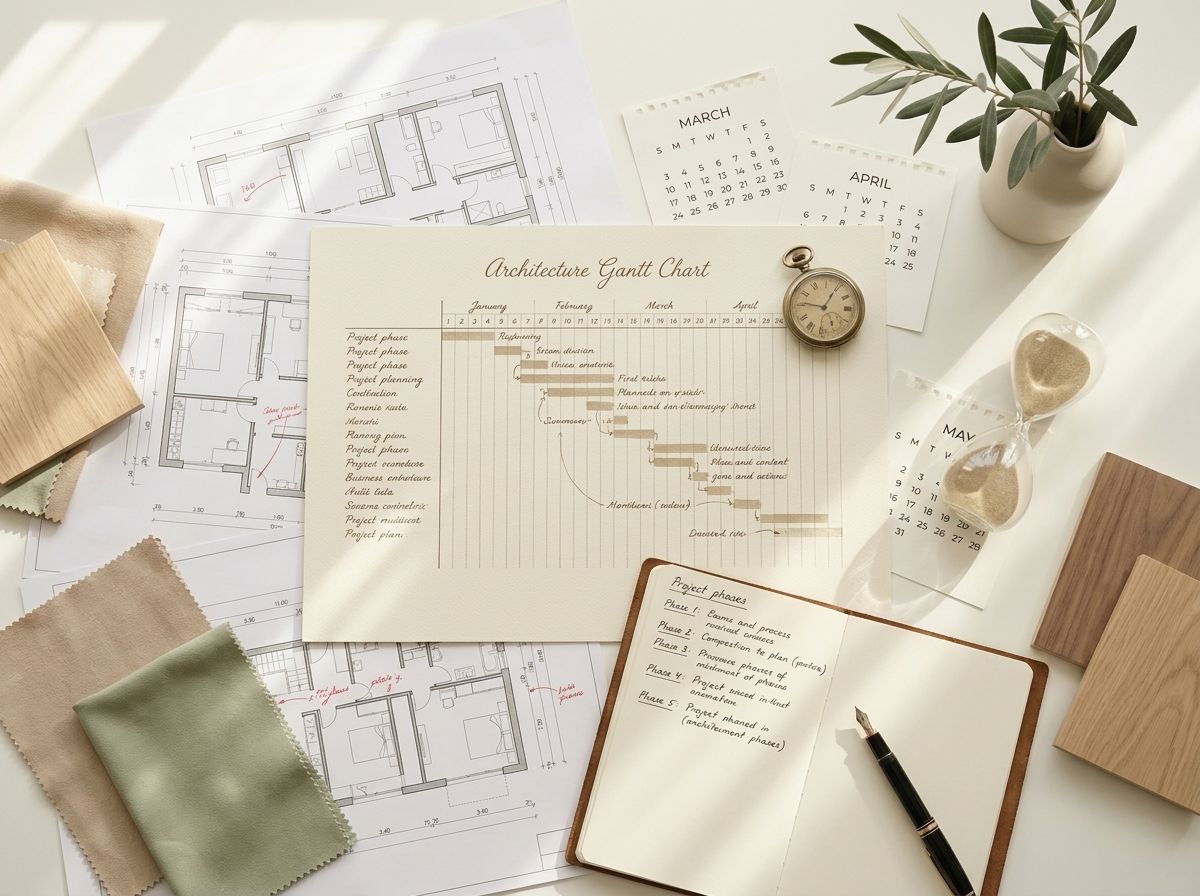
An interior design project does not unfold in a straight line. Several phases overlap, and certain decisions unlock the next steps. Here is the realistic chronology as we work it.
1. Briefing and technical survey: 1 to 3 weeks
This phase begins after contract signature. It includes the in-depth meeting, space analysis, precise measurements, and brief definition. With a responsive client, it can wrap up within two weeks for a standard apartment.
2. Concept and preliminary design: 3 to 6 weeks
This is where the creative direction takes shape: moodboards, palette, first 2D layouts, and first 3D views. Duration depends on the number of iterations. Three to four exchanges are usually enough to land on a validated direction.
3. Detailed design and execution drawings: 4 to 8 weeks
Once the concept is approved, the studio produces all technical documents: dimensioned drawings, electrical and lighting plans, custom millwork details, precise selection of materials and finishes. This phase is what makes the construction site truly executable. Rushing it guarantees problems further down the line.
4. Permit application (if required): 4 to 12 weeks
This point is specific to Switzerland and changes everything. For a project without structural changes, no permit is required: paint, flooring, furniture, and like-for-like kitchen replacements proceed without procedure. For larger interventions, two procedures coexist in French-speaking cantons: the notification procedure (around 30 days) for minor interior work, and the ordinary procedure (8 to 12 weeks, sometimes more in case of objections) for structural changes, change of use, or listed buildings.
Important: in Geneva, Vaud, and other cantons, timelines can extend significantly when neighbours object. Anticipating communication with neighbours when relevant can save several weeks.
5. Orders and manufacturing: 8 to 20 weeks
This is often the longest phase, and the one that surprises homeowners most. A custom kitchen takes 8 to 12 weeks to manufacture. High-end European furniture: 12 to 20 weeks. A custom Italian sofa: 14 to 18 weeks. Materials such as natural stone, marble, or certain Italian tiles can take 6 to 10 weeks from order. An experienced studio places orders early and synchronizes deliveries with site progress.
6. Construction and handover: 8 to 30 weeks
For a standard apartment renovation, allow 12 to 16 weeks of actual construction. For a villa, 20 to 30 weeks. Construction includes demolition, masonry, electrical work, plumbing, flooring, painting, kitchen and bathroom installation, and finally the placement of furniture. Tight trade coordination reduces idle time.
Why timelines in Switzerland differ from elsewhere
Several factors explain why projects in French-speaking Switzerland take a bit longer than in other European countries, and it pays to know them in advance.
Execution quality is high. Swiss craftsmen deliver very refined finishes, which takes more time than in markets with looser standards. Skilled trades are heavily booked. Good cabinet makers, electricians, and tilers in French-speaking Switzerland are in demand and often plan several months ahead. Cantonal coordination adds administrative steps, especially for properties in protected zones in Geneva’s Old Town, Lausanne’s historic centre, or in Vevey, Morges, Nyon, or Montreux. Import lead times for European or Italian furniture must be anticipated, particularly between April and July, the peak demand season.
The 5 factors that stretch a project
Beyond the theoretical schedule, some elements consistently push timelines out. They are almost always the same.
Indecision. A one-week delay on a flooring choice can shift the whole site by several weeks, because it blocks downstream orders. Mid-project scope changes. Redrawing a kitchen layout after components have been ordered means going back a month. Structural surprises, especially in older buildings in central Geneva or Lausanne: asbestos, instabilities, outdated piping. Delivery delays, particularly on custom or imported pieces. Neighbour objections during permit applications, which can add several months.
An experienced studio keeps margin in the schedule and anticipates these issues. At RK Interiors, we systematically share the critical milestones so you know exactly when each decision needs to be made.
How to speed up a project without compromising quality
Several levers shorten timelines without sacrificing the result. Almost all of them come down to preparation and client availability.
Start the project several months before your target completion date. Beginning design between 2 and 4 months before the planned construction start gives time to choose well and to order early. Define non-negotiables clearly at the briefing stage. The more precise the brief, the fewer revisions afterwards. Favour readily available materials. Catalogue items arrive in weeks, while custom pieces can take months. Centralise coordination with one point of contact. Multiplying intermediaries multiplies delays. React quickly to validations. Three days to confirm a material board is usually enough.
The 2028 fiscal window and why planning early matters
One specific point in the Swiss context is worth flagging. The reform of imputed rental value, approved in September 2025, removes most tax deductions linked to maintenance and renovation work for owners occupying their primary residence, starting in 2028.
In practice, this means works engaged and invoiced before that deadline remain under current tax rules. For a homeowner considering a substantial renovation, this changes the calendar question: a project launched in 2026 still benefits from current rules, while a project pushed to 2028 or beyond will lose much of its tax advantage. Given the durations we have just outlined, starting the design phase now is a sensible decision for homeowners in French-speaking Switzerland.
Planning your project with confidence
An interior design project in Switzerland takes time, but that time is measurable. A standard apartment is 6 to 9 months. A villa, around a year. A chalet, a little longer. Knowing these ranges in advance allows you to make informed decisions about the right moment to start and how to organise your life around the construction phase.
RK Interiors supports residential and commercial projects in Lausanne, Geneva, Nyon, Montreux, Vevey, Morges, Versoix, Cologny, Coppet, Anières, Collonge-Bellerive and across French-speaking Switzerland, as well as in Chamonix and the wider Lake Geneva area. To discuss your project and receive a detailed timeline estimate, contact us. The first conversation comes with no commitment.