
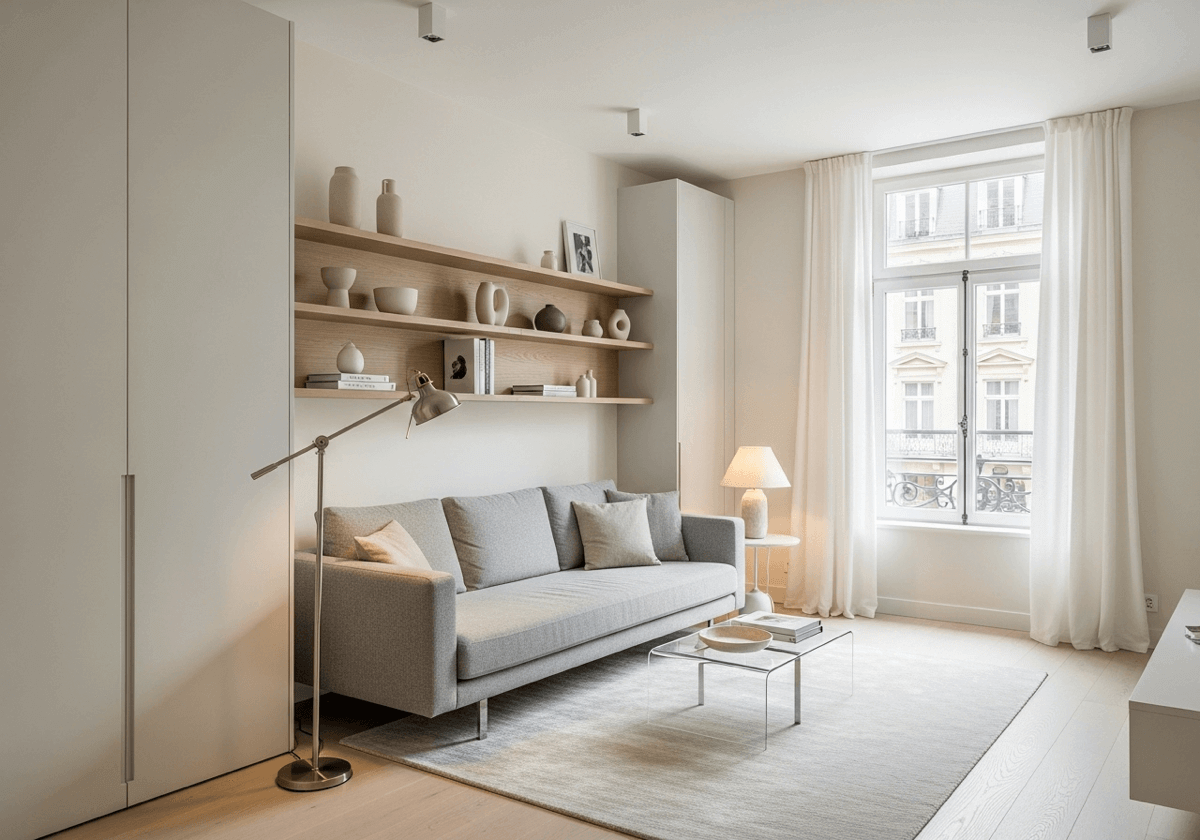
How to Optimize a Small Space: Circulation, Lighting and Furniture Choices
To optimize small space does not simply mean reducing the number of objects or selecting smaller furniture. It requires strategic thinking about circulation, light hierarchy, proportion and spatial perception.
In a small apartment layout, every decision has a visible impact. An incorrect scale, poor placement or an overloaded palette can quickly create visual congestion. On the other hand, precise technical decisions can transform compact interiors into fluid, luminous and harmonious environments.
Read Circulation Before Adding Furniture

The first step to optimize small space is understanding circulation.
In compact environments, even minor obstacles become disruptive. A poorly positioned dining table can block movement. An oversized sofa can interrupt natural flow.
Before selecting furniture, it is essential to analyze:
• Primary movement paths
• Frequently used circulation zones
• Natural light entry points
• Functional connections between areas
A successful small apartment layout depends on fluid circulation. Ideally, movement should feel intuitive and uninterrupted.
Key professional guidelines include:
– Keep pathways clear and continuous
– Avoid sharp corners in narrow areas
– Favor linear or curved transitions
– Position furniture against walls when it enhances flow
A sense of spaciousness begins with freedom of movement.
Establish a Lighting Hierarchy to Expand Perception
Lighting is one of the most powerful tools to optimize interior space.
In small interiors, relying on a single central ceiling light often creates harsh shadows and reduces perceived depth.
A professional lighting strategy includes three layers:
Ambient lighting to define overall atmosphere.
Task lighting to support specific functions.
Accent lighting to create depth and visual interest.
Layered lighting reduces contrast and increases dimensional perception. Wall sconces, integrated LED strips and table lamps help expand visual boundaries.
Material finishes also influence light behavior. Matte surfaces diffuse light softly. Slightly reflective materials amplify brightness without creating overwhelming glare.
To optimize small space effectively, light must be treated as invisible architecture.
Choose Proportional and Intelligent Furniture
One common mistake in a small apartment layout is selecting furniture that is simply smaller rather than proportionally appropriate.
Furniture should be balanced in scale, not undersized.
A sofa that is too narrow may look fragile. A heavy coffee table may dominate circulation.
Professional considerations include:
• Prioritize low-profile furniture to preserve vertical perception
• Choose visible legs to create visual lightness
• Avoid excessively high backs in compact rooms
• Integrate multifunctional pieces
Modular and built-in solutions are highly effective when aiming to optimize interior space without visual overload.
Custom furniture can maximize every centimeter and eliminate wasted gaps common with standard pieces.
Use Vertical Storage to Free the Floor

In compact interiors, floor space is invaluable.
Vertical storage is a strategic solution to optimize small space. Utilizing wall height preserves circulation while increasing storage capacity.
Full-height shelving, integrated wardrobes and wall-mounted units shift volume upward and maintain openness.
However, balance is essential. Overloading upper areas can visually compress the room.
An effective approach alternates:
– Closed storage to conceal clutter
– Open niches to lighten composition
– Vertical alignments that follow architectural lines
Well-designed storage transforms limited square footage into an organized and calm environment.
Reduce the Color Palette to Strengthen Unity
An overly fragmented palette visually shrinks a space.
To optimize interior space, limiting chromatic variation is recommended.
This does not require an all-white environment. Instead, it calls for visual continuity.
A cohesive neutral base combined with subtle accents creates depth and refinement.
In a small apartment layout, chromatic unity helps:
• Extend visual boundaries
• Minimize abrupt transitions
• Reinforce spatial coherence
Sharp contrasts break continuity. Soft transitions expand perception.
Use Texture to Add Depth Without Overloading
When color variation is restrained, texture becomes the primary source of richness.
In small interiors, depth should come from materials rather than multiple colors.
Natural wood, textured fabrics, matte stone and brushed metal introduce visual interest without fragmentation.
Textures interact differently with light, creating subtle variations that enrich the environment.
To optimize small space successfully, the goal is controlled complexity rather than excessive simplification.
Create Measured Focal Points
A compact interior without hierarchy can feel flat and undefined.
Introducing a measured focal point structures perception. This may include:
• A curated artwork
• A softly illuminated niche
• A textured feature wall
• A sculptural furniture piece
A focal point directs attention and shifts focus away from physical dimensions.
Moderation remains essential. Too many focal elements create visual congestion.
Common Mistakes to Avoid
When aiming to optimize small space, avoid:
Accumulating excessive decorative objects
Using multiple unrelated color schemes
Blocking natural light with heavy curtains
Placing furniture centrally without purpose
Neglecting integrated storage solutions
Every design decision should support fluidity and perception.
Why Professional Strategy Makes a Difference
A well-designed compact interior often feels larger than its actual dimensions.
The difference lies not in decoration but in strategy.
To optimize interior space effectively requires:
• Architectural reading
• Lighting expertise
• Proportional accuracy
• Material coherence
• Holistic vision
A structured approach prevents improvised compromises and maximizes existing potential.
Conclusion
To optimize small space is an exercise in precision.
It requires balancing circulation, lighting, furniture and perception to transform compact interiors into refined, fluid environments.
Every technical decision shapes daily experience.
Every centimeter becomes strategic.
Every choice influences spatial clarity.
If you are considering a small apartment layout or seeking expert small space ideas to optimize interior space in your home, our team is ready to guide you through a structured and refined process.