
What is included in interior design? A clear guide for homeowners in Switzerland
Before signing a contract with an interior design studio, almost everyone asks the same question: what exactly do I get? The word “project” covers very different realities depending on the studio, and that lack of clarity remains one of the main sources of client frustration.
At RK Interiors, a studio based between Lausanne and Geneva, we believe a well-informed client is a confident client. This guide breaks down what is actually included in an interior design project in Switzerland, step by step, and what is not. The goal is simple: to help you move forward knowing exactly what to expect.
Interior architecture, decoration, home staging: what is the difference?
Before going into detail, a useful clarification. These three services are often confused, even though they answer very different needs. Decoration is about dressing an existing space without changing its structure. Home staging aims to enhance a property for sale, with limited resources. An interior design project, by contrast, rethinks the space in depth: volumes, flow, light, materials, furniture and technical elements are coordinated together.
That integral dimension is what justifies professional support. And it is also why a well-defined project from the start makes all the difference.
The 5 phases of an interior design project
A serious project follows a structured path. Names vary from one studio to another, but the logic remains the same. Here is the concrete breakdown as we practise it at RK Interiors.
1. Briefing and space analysis
Everything starts with an in-depth meeting. We listen to how you live, your daily constraints, your preferences, your non-negotiables. Then comes the technical survey: precise measurements, verification of electrical and water connections, ceiling heights, structural constraints. The output of this phase is a brief that acts as a compass for the entire project.
2. Concept and preliminary design
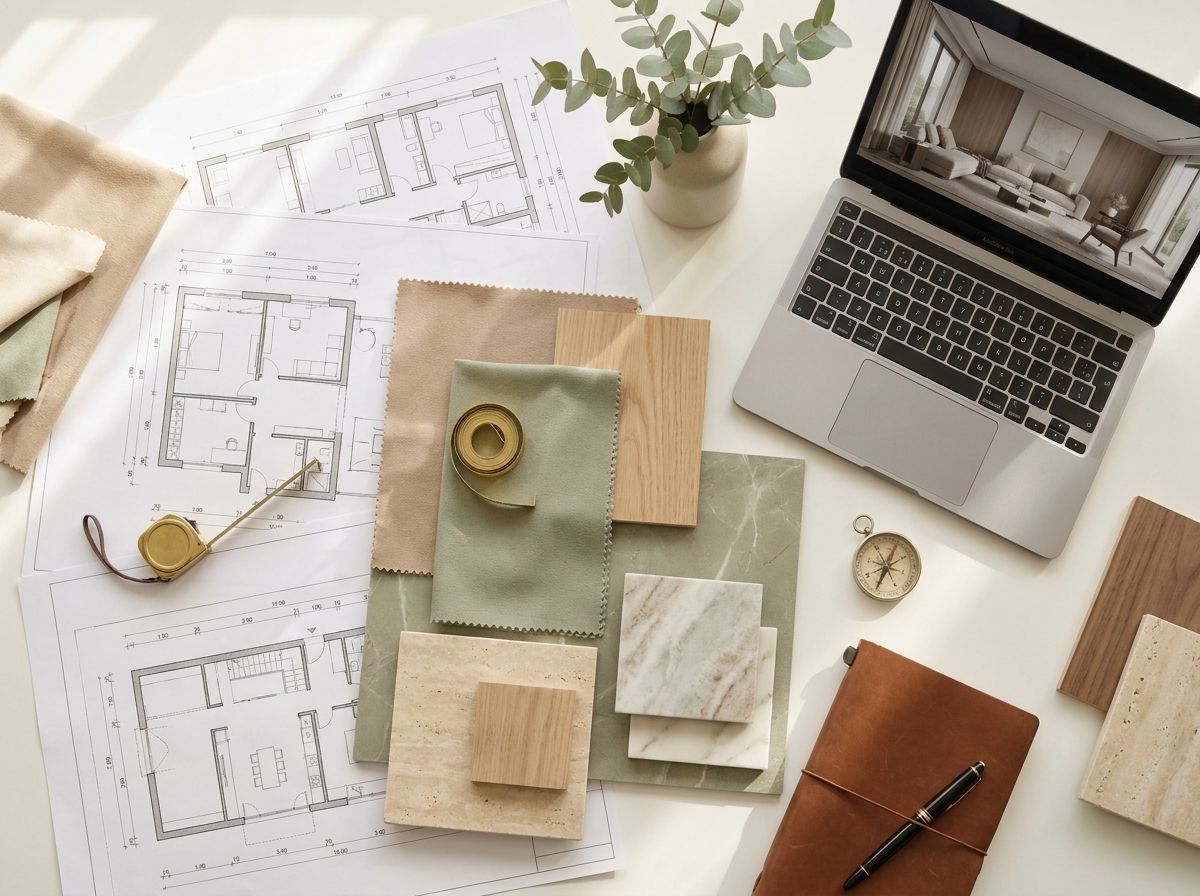
Based on the brief, we propose a clear creative direction: atmosphere, colour palette, material selection, first layout plans. This is when the space begins to take shape. You receive moodboards, 2D plans, and often the first 3D views. This phase is iterative. We refine until we land on a direction that genuinely matches you.
3. Detailed design and execution drawings
Once the concept is validated, we move to the technical level. Dimensioned execution drawings, electrical plans, lighting plans, elevations, custom millwork details, precise selection of finishes and surfaces, sanitary fixtures, built-in furniture and free-standing pieces. This is the reference document your trades will use on site.
4. Trade coordination and site management
This is where the value of a studio becomes particularly evident. We coordinate the trades, request quotes from contractors, validate orders, schedule the sequence of interventions, and carry out regular site visits. When something unexpected comes up (and it always does), we find the solution without interrupting the rhythm of the project.
5. Handover and final installation
The last phase covers everything that turns a finished site into a livable space: furniture installation, lighting setup, artwork hanging, accessory styling, last adjustments. This is the final touch that gives the place its definitive atmosphere.
What is concretely included in an RK Interiors project
Beyond the five phases, here is what a client actually receives when entrusting us with a complete interior design project. Transparency on these deliverables is essential to avoid grey areas.
In-depth needs assessment and briefing. Complete technical survey of the space. Layout and circulation plans. Creative concept with moodboards and material palette. Photorealistic 3D views of the main spaces. Dimensioned execution drawings. Electrical, lighting and luminaire plans. Plumbing plans for wet areas. Technical details for millwork and custom furniture. Detailed selection of materials, finishes and surfaces. Free-standing furniture and accessories list (FF&E). Quote requests and review with contractors. Trade coordination on site. Regular site visits. Delivery validation and final furniture installation.
The RK Interiors difference: neuroarchitecture and biophilic design built in
Not all studios work the same way, and that is often where the final quality of a project is decided. At RK Interiors, every decision is filtered through neuroarchitecture and biophilic design. In practice, this means the layout of spaces, the quality of natural light, the choice of materials and the proportions are designed to support your focus, rest and well-being on a daily basis.
This approach does not add cost to a well-managed project. It is simply part of how we work. It is what distinguishes a beautiful space from a space that genuinely makes you feel better.
What is not included in an interior design project
In the spirit of honesty, here are the items that are generally not part of an interior design project in Switzerland, and which you should plan for separately or through partner providers.
Structural work requiring a building permit (extension, load-bearing wall changes) typically falls under an architect. Thermal and energy studies fall under specialised engineers. Administrative procedures with cantonal authorities are usually handled by the homeowner or the architect. Material and furniture purchases are paid by the client (unless a procurement mission is explicitly included). Site insurance and works guarantees are issued by the contractors. Direct payment of trades is not made by the studio, but by the project owner.
A serious studio clearly states what is included, what is not, and points you to the right contacts when needed. It is a sign of professionalism to look for as early as the fee proposal.
How long does an interior design project take in Switzerland?
Duration varies with scale. For an apartment of 100 to 150 m² with full renovation, expect on average between 6 and 12 months from first briefing to final handover. For a project including kitchen and bathrooms, plan for the upper end. For a chalet or villa, timelines can reach 12 to 18 months depending on complexity.
The design phase represents roughly a third of the total time. The actual construction takes up the rest, and is also the phase most exposed to unforeseen issues. An experienced studio anticipates these and keeps margin in the schedule. That is one of the main differences between a well-managed project and one that drifts off course.
How to evaluate an interior design proposal
Before signing, ask any studio you are considering the following questions. The answers will tell you a lot about what comes next.
Which phases are precisely included in the mission? How many concept revisions are allowed before validation? What deliverables will I receive, and in what format? How are scope changes handled mid-project? Who coordinates the trades, and who carries the responsibility? How frequent are the site visits? Is there a guarantee of project completion?
A studio that answers these questions directly is a studio you can rely on. At RK Interiors, we systematically document each of these points in our initial proposal.
Starting a project with confidence
Understanding what is included in an interior design project is already half the path to approaching renovation work calmly. The rest is built through the relationship with your studio: trust, attentive listening, and clarity on what is delivered, when, and by whom.
RK Interiors supports residential and commercial projects in Lausanne, Geneva, Nyon, Montreux, Vevey, Morges, Versoix, Cologny, Coppet, Anières, Collonge-Bellerive and across French-speaking Switzerland, as well as in Chamonix and the broader Lake Geneva area. To discuss your project and receive a detailed, costed proposal, contact us. The first conversation comes with no commitment.