
Marie Claire – Interior Design: Durable Outdoor Furniture, from the Ephemeral to the Timeless
Marie Claire – Interior Design: Durable Outdoor Furniture, from the Ephemeral to the Timeless
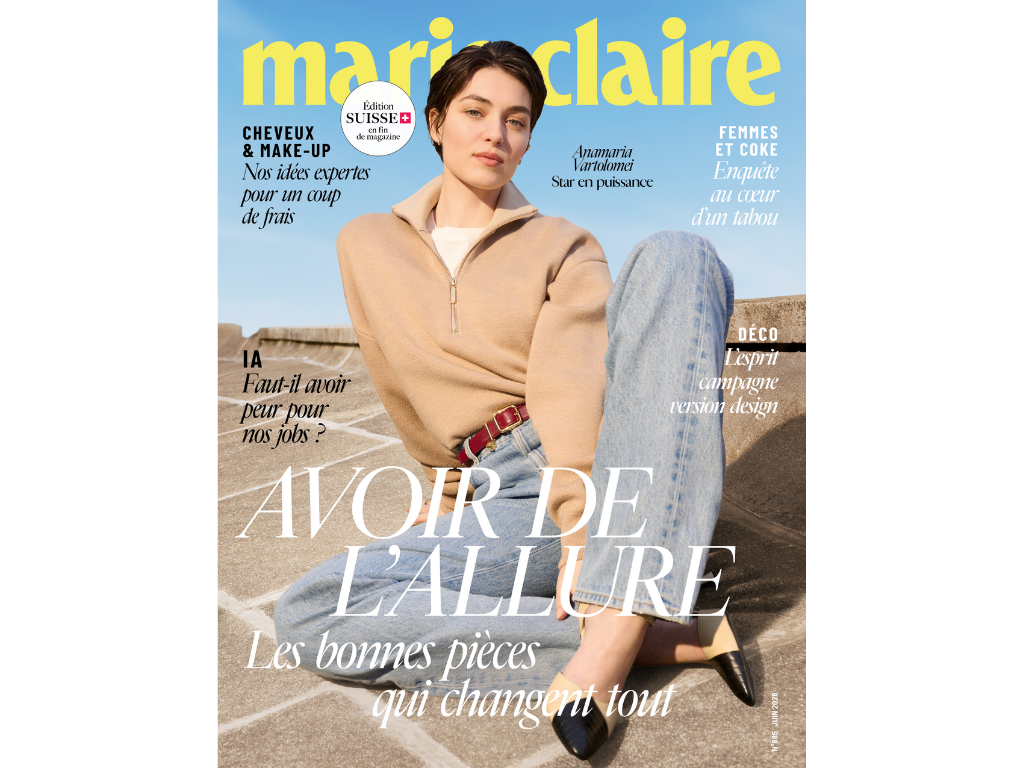
In the June 2026 edition of Marie Claire Switzerland, Renata Koglin, interior architect and founder of RK Interiors, offers a new perspective on outdoor spaces. Long relegated to a secondary role, terraces, gardens and patios are now affirming themselves as genuine extensions of the home. Through the lens of neuro-architecture and biophilic design, she presents durability as the new luxury, where comfort, beauty and the conscious choice of materials come together.
From the ephemeral to the timeless
For Renata, outdoor furniture has long been associated with a short lifespan, dictated by the seasons and by wear. Today, that logic is fading in favour of a more enduring, almost architectural approach. Houses such as Cane-line, Tribù and Kettal contribute to this evolution with collections defined by precise lines, balanced proportions and materials designed to age over time.
Teak develops a patina, mineral surfaces settle in, and structures grow refined. Yet not all materials age the same way: some improve, others deteriorate. Learning to recognise that difference becomes essential in a sustainable approach.
Comfort as a contemporary necessity
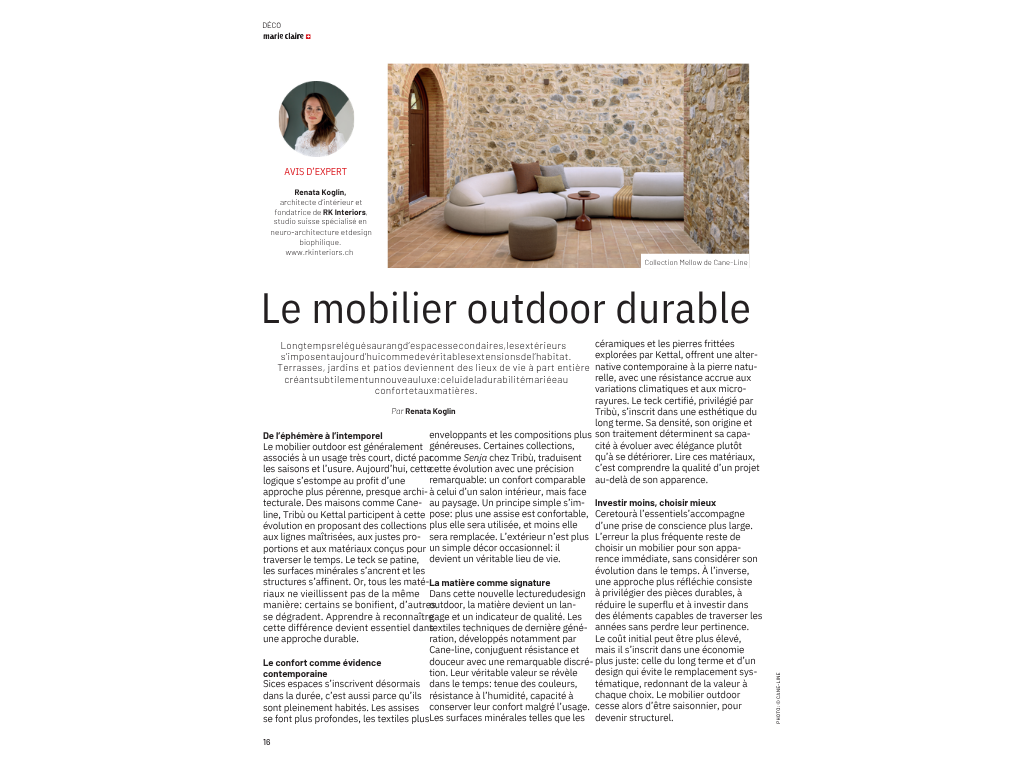
If these spaces now belong to the long term, it is also because they are fully lived in. Seats grow deeper, textiles more enveloping, compositions more generous. Collections such as Tribù’s Senja translate this evolution with remarkable precision: a comfort comparable to that of an indoor living room, yet open to the landscape.
A simple principle takes hold: the more comfortable a seat is, the more it will be used, and the less it will be replaced. The outdoors stops being an occasional backdrop and becomes a true place to live.
Material as signature
In this new reading of outdoor design, material becomes a language and a marker of quality. The latest-generation technical textiles, developed in particular by Cane-line, combine resistance and softness with remarkable discretion. Their real value reveals itself over time: colour fastness, resistance to humidity, the ability to maintain comfort despite continued use.
Mineral surfaces such as the ceramics and sintered stones explored by Kettal offer a contemporary alternative to natural stone, with enhanced resistance to climatic variations and micro-scratches. Certified teak, favoured by Tribù, belongs to a long-term aesthetic. Its density, origin and treatment determine its ability to evolve with grace rather than deteriorate. Reading these materials is what allows you to understand the quality of a project beyond its appearance.
Invest less, choose better
This return to the essential comes with a broader awareness. The most common mistake remains choosing furniture for its immediate appearance, without considering how it will evolve over time. The opposite approach, more considered, is to favour durable pieces, to reduce the superfluous and to invest in elements capable of crossing the years without losing relevance.
The initial cost may be higher, but it belongs to a fairer economy: that of the long term and of a design that avoids systematic replacement, restoring value to every choice. Outdoor furniture stops being seasonal and becomes structural.
With this publication in Marie Claire, Renata once again affirms her distinctive approach to interior design: one where emotion, well-being and conscious living are at the core of how we inhabit our spaces, indoors and out.